
GitHub Copilot delivers some of its most notable impact in day-to-day workflows. As developers write, understand, and maintain code, Copilot enhances both speed and quality through more reliable, context-aware interactions.
It accelerates routine tasks such as generating new endpoints, transforming logic, updating tests, and identifying coverage gaps. Developers can use natural language to explore codebases, trace data flows, or clarify complex functions, reducing cognitive load. In pull requests, Copilot assists with automated reviews, suggests improvements, and enables developers to apply fixes directly with a single approval step.
These are not isolated demonstrations—they represent patterns teams can standardize to improve consistency, reduce rework, and strengthen long-term maintainability across repositories.
Scaling Adoption Across the Enterprise

As Copilot moves beyond early pilots, organizations are recognizing the need for a structured approach to adoption. Individual experimentation creates early momentum, but meaningful enterprise impact requires shared practices, consistent enablement, and alignment across engineering leadership.
Teams typically progress from isolated trials to broader adoption, but without a defined operating model, usage often varies widely. Scaling Copilot successfully involves clarifying how it fits into development workflows, establishing coding and review standards, and enabling developers and technical leads to incorporate AI-assisted development confidently.
Organizations that invest in these foundations create an environment where Copilot can deliver reliable improvements in productivity, quality, and developer satisfaction.
Measuring Sustained Enterprise Impact

As organizations formalize their approach to GitHub Copilot, measurement becomes critical. Early productivity anecdotes provide useful signals, but long-term value is demonstrated through consistent improvements across development teams, repositories, and delivery cycles. Mature organizations assess Copilot’s impact through a balanced set of metrics that reflect developer experience, engineering effectiveness, and outcomes at the organizational level.
Developer Productivity:
Teams track indicators such as reduced time spent on boilerplate, faster onboarding to new projects, improved test coverage, and lower cognitive load when navigating complex systems. These measures help organizations understand how Copilot supports daily development work and strengthens the developer experience.
Developer Experience:
Organizations measure satisfaction, confidence, and engagement with Copilot. Indicators such as cognitive load reduction, willingness to explore unfamiliar codebases, and the perceived quality of the development experience provide insight into how Copilot affects day-to-day workflows and long-term retention.
Organizational Velocity:
The emphasis shifts toward strategic outcomes: improved lead-time for changes, increased deployment frequency, reduced operational burden, and more predictable delivery patterns. These indicators reflect how Copilot supports scalable engineering practices and enables teams to meet growing business demands with greater confidence and consistency.
The Future Is Agentic
Software development is entering a new phase shaped by agentic systems. GitHub Copilot is progressing from an assistive capability into a platform for AI agents that can understand intent, plan multi-step tasks, and execute work under developer supervision. This shift signals a broader change in engineering, where AI plays an increasingly active role in creating, maintaining, and improving software.
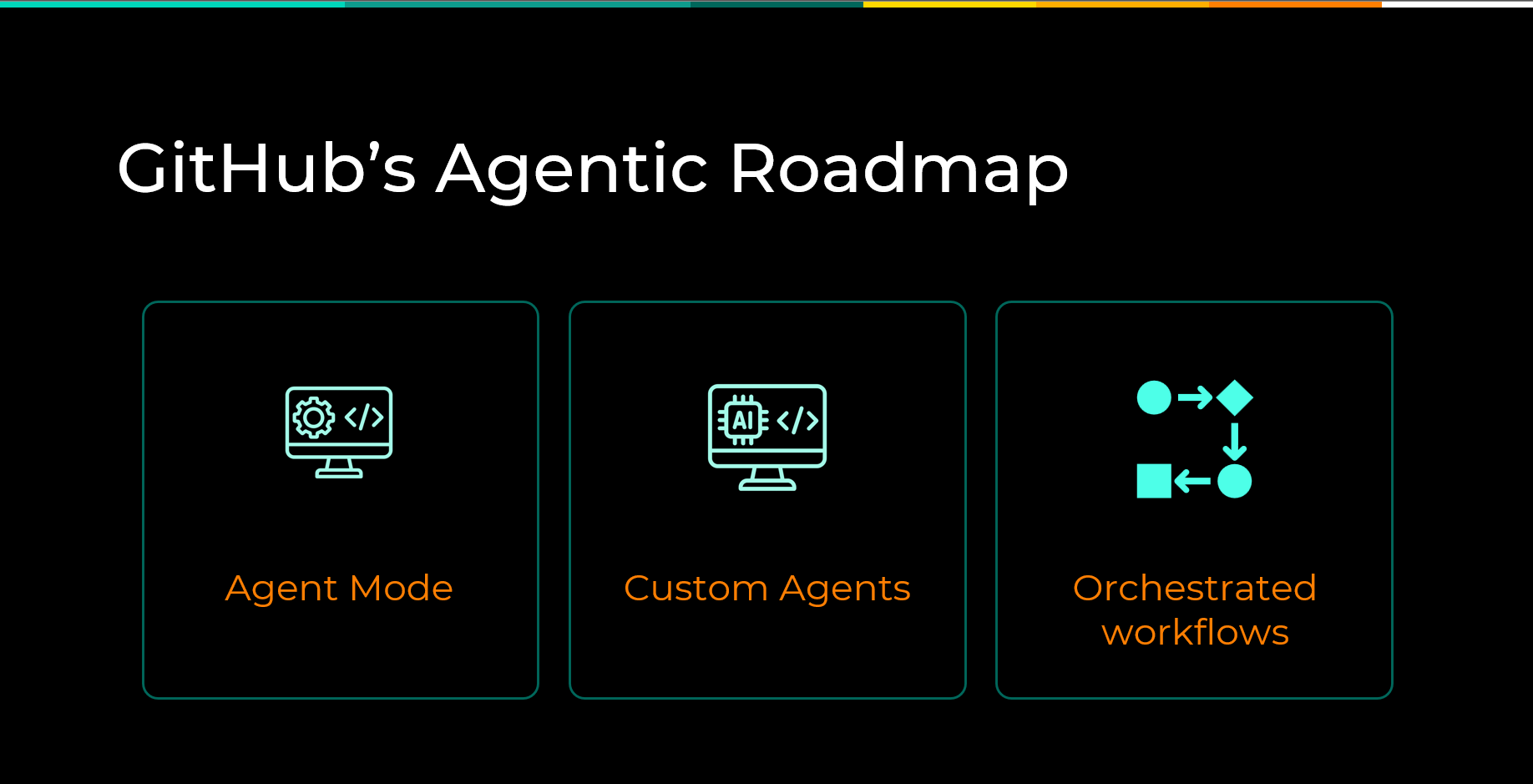
GitHub’s agentic roadmap outlines three foundational capabilities that will define this next era:
Agent Mode: A deeper execution model that allows Copilot to perform tasks such as drafting pull requests, preparing tests, updating documentation, or applying structured changes across a repository. These workflows extend beyond single prompts and move toward delegated execution.
Custom Agents: Configurable agents tailored to the unique characteristics of an organization’s codebase. These agents can be designed to reflect domain-specific patterns, architectural constraints, naming conventions, or compliance requirements—enabling consistent, repeatable actions aligned with internal standards.
Orchestrated Workflows: Collaborative systems in which multiple agents support distinct parts of the development lifecycle. One agent may focus on testing, another on implementation or refactoring, and another on documentation or compliance. Developers guide intent and validate outputs, while agents handle well-defined, repeatable tasks.
As these capabilities mature, developers will increasingly coordinate work across human and AI contributors. The role shifts toward guiding intent, reviewing outcomes, and steering the engineering system as a whole. Organizations that prepare now—with strong governance, thoughtful enablement, and adaptable engineering practices—will be best positioned to benefit from the next generation of AI-enabled development.
Patterns for Long-Term Success

Sustained impact with GitHub Copilot depends on more than deployment. Organizations that achieve meaningful, repeatable gains share consistent patterns in how they structure adoption, support teams, and integrate Copilot into existing engineering practices. These patterns serve as a foundation for long-term success and help transform early momentum into durable capability.
Leadership Alignment:
Treat Copilot as a strategic capability rather than a productivity add-on. Clear alignment across engineering, product, and technology leadership ensures that adoption is tied to measurable outcomes and supported through ongoing investment.
Developer Enablement:
Long-term success requires structured enablement that helps teams build confidence and competence with AI-assisted development. Training programs, onboarding playbooks, and communities of practice create shared understanding and reduce friction during adoption.
Integration into Standards:
Organizations seeing the strongest results embed Copilot into software development processes. Coding standards, pull-request guidelines, documentation expectations, and testing practices evolve to incorporate AI-assisted workflows, creating consistency across repositories and teams.
Governance and Guardrails:
Effective governance provides clarity and accelerates adoption. Guardrails around model usage, repository access, and quality expectations ensure safe scaling while empowering developers to use Copilot broadly and confidently.
These patterns strengthen engineering foundations and position organizations to achieve durable improvements in velocity, quality, and developer experience.
Conclusion
The software development landscape is evolving quickly. As AI capabilities mature, teams are shifting from isolated experiments to scalable practices that incorporate GitHub Copilot into the core of their engineering workflows. Organizations that invest in governance, enablement, and adaptive development standards today will be best positioned to capture the benefits of agentic systems.