
In our previous post, we introduced the three pillars of trust – contracts, evidence, and gates, that make agentic software development safe. But two questions remain: “How do we know when we’re ready for more autonomy? And what’s the ROI?” The answer isn’t a feeling. It’s a ladder. A progression of phases where each rung has clear outcomes, measurable results, and the skills needed to climb higher. You don’t skip rungs. You climb.
This post maps the maturity ladder from foundation to autonomous delivery, with business outcomes at every step.
The Destination: Three Levels of Human Involvement
Before climbing the ladder, understand where you’re headed: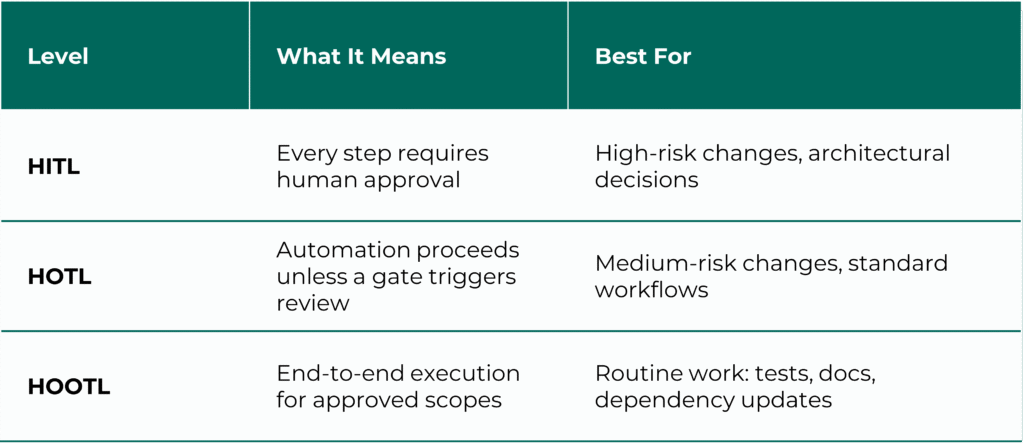 The goal isn’t to remove humans, it’s HOOTL for work that doesn’t need human judgment, so humans can focus on work that does.
Phase 1: Foundation
Leadership question: “Does my team have the skills to use AI effectively?”
What you build: Shared vocabulary and baseline skills across all developers. Champions certified to lead adoption. A maturity assessment that identifies pilot teams.
Skills and concepts you learn:
- Stakeholder change management: Addressing fear and skepticism before technical implementation. Organizations that handle human factors first see 10-30% efficiency gains; those that don’t often see failed rollouts collapse within 12 weeks.
- Success metrics definition: Establishing measurable KPIs before adoption begins, not after.
- The autonomy ladder: Understanding HITL → HOTL → HOOTL as a progression, not a choice.
Business Outcome
Teams with consistent AI skills avoid the chaos of inconsistent usage patterns. The shared vocabulary enables everything that follows.
Duration: 3-4 weeks
Phase 2: Trust & Contracts
Leadership question: “Can I trust what the agent tells me?”
What you build: The infrastructure that makes agent outputs verifiable. Branch protections ensure all changes go through CI. JSON schemas define valid output. Citation discipline means every claim has a source.
Skills and concepts you learn:
- Deterministic CI/CD foundations: Eliminating flaky tests and ensuring reproducible builds. If your CI is unreliable, agent automation will amplify the chaos.
- Schema-driven development: Converting vague requirements into reviewable, diffable contracts that CI validates automatically.
- Stop/Ask triggers: Agents halt and request clarification rather than hallucinate. This eliminates “sounds right but is wrong” syndrome.
- Evidence quality rubrics: Measurable standards for traceability (GOLD/SILVER/BRONZE ratings).
Business Outcome
Schema validation catches errors at generation time, not production. When a VP needs technical debt data for board reporting, agents produce weekly validated reports. The answer is always current, no manual compilation.
Duration: 4 weeks
Phase 3: Understanding
Leadership question: “Does the agent understand my codebase before changing it?”
What you build: Read-only analysis capabilities. Agents prove comprehension through discovery artifacts before earning write permissions. Context graphs map how code connects.
Skills and concepts you learn:
- Prove understanding before writing: Agents demonstrate knowledge through auditable artifacts. Verification happens when changes are cheap, not after deployment.
- Dependency mapping from source: Building relationship graphs from actual code (CODEOWNERS, imports, config), not AI memory.
- Blast radius calculation: Quantifying “if I change X, what else breaks?” before making changes.
- Risk-aware planning: Using graph data to route high-impact changes to appropriate reviewers automatically.
Business Outcome
A product team planning a major feature gets an impact report before any code is written: “4 services affected, 7 downstream consumers, EventBus has no integration tests (risk).” Sprint planning includes evidence-based estimates.
Duration: 4 weeks
Phase 4: Verification & Security
Leadership question: “Are agent outputs validated before action?”
What you build: Independent verification that separates the verifier from the creator. Plugin-based quality gates. Security controls for prompt injection, secrets, and audit trails.
Skills and concepts you learn:
- Separation of concerns: The verifier agent is never the same agent that created the artifact (preventing self-approval).
- Remediation guidance: Verification failures include actionable fix instructions, not just error messages.
- Prompt injection defense: Detecting and blocking attempts to hijack agent behavior.
- Audit trails for compliance: Every agent action logged for SOC2, HIPAA, and regulatory requirements.
Business Outcome
Security and compliance teams can approve AI-assisted workflows without special exemptions. Junior engineers merge with confidence when verification passes; seniors focus on architecture. Automates code review grunt work.
Duration: 4 weeksPhase 5: Gated Writes
Leadership question: “Can I safely let the agent modify code?”
What you build: Risk-based policies that control when agents can write. Rollback plans for every change. Multi-candidate generation to get the best approach.
Skills and concepts you learn:
- Read-before-write pattern: Mandatory discovery and verification before any code modification. Every line of generated code traces to a verified plan.
- Risk classification gates: Low/medium/high/critical determines approval requirements. Low-risk may auto-merge; high-risk requires explicit sign-off.
- Executable rollback plans: Every deployment includes automated recovery steps as a prerequisite. Recovery happens in minutes, not hours.
- Parallel candidate generation: Running multiple agents on the same task to get diverse approaches, then ranking by objective metrics.
Business Outcome
A platform team deprecating v1 API endpoints—normally a multi-quarter project—completes in 6 weeks. Low-risk changes auto-merge; medium-risk requires one approval; high-risk requires API owner sign-off.Duration: 4 weeks
Phase 6: Scale & Autonomy
Leadership question: “Can the agent deliver end-to-end without manual intervention?”
What you build: Bounded scopes where agents operate HOOTL. Multi-agent pipelines for complex workflows. Observability dashboards tracking success rates and ROI.
Skills and concepts you learn:
- Scope allowlists: Explicit contracts defining what can auto-merge (docs, tests, deps) vs. what requires review. Review by exception, not by default.
- Specialized agent pipelines: Discovery, planning, testing, and verification as separate expert agents with clear handoffs.
- Emergency brake mechanisms: Instant halt capability for all automation when needed.
- Agent performance dashboards: Tracking rejection rates, human edit rates, time-to-green, and quality drift detection.
Business Outcome
When a PM creates a feature spec, the agent generates implementation candidates with full test coverage, deploys to ephemeral environments, and auto-promotes the winner to staging. Senior engineers stop reviewing typo fixes and focus on the 5% of decisions that truly need expertise.
Duration: 4 weeks
The ROI Reality
Organizations that climb the ladder methodically see measurable returns:
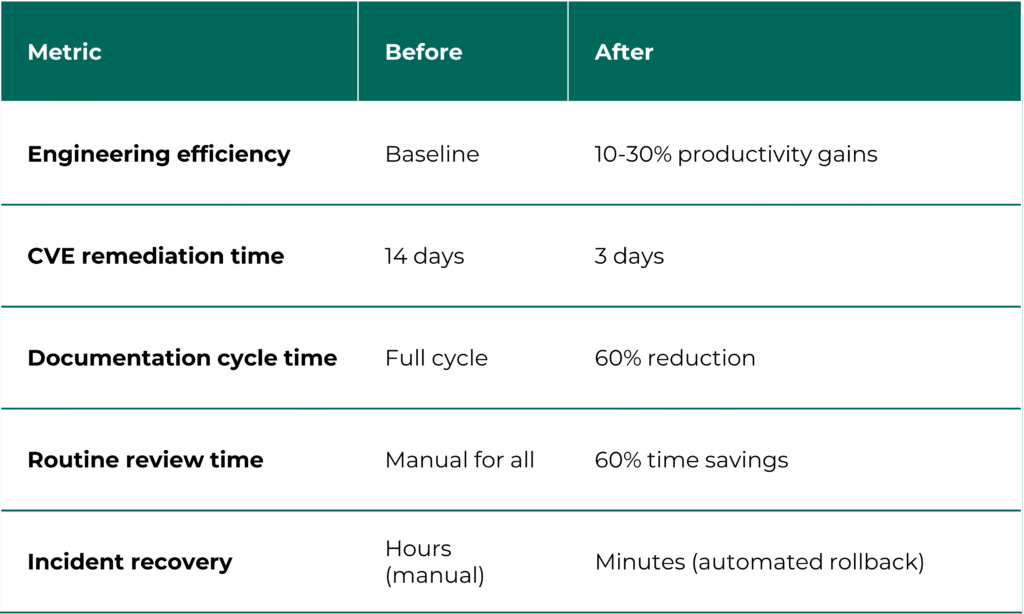
The key insight: These gains come from shifting human effort, not eliminating it. Engineers spend less time on routine verification and more time on architecture, strategy, and novel problem-solving.
The gains compound: Phase 2 enables Phase 3. Phase 4 unlocks Phase 5. Organizations that try to skip to Phase 6 without the infrastructure often regress and lose stakeholder trust.
Where to Start
- Assess your current phase. What’s the highest rung where all capabilities are operational?
- Target the next phase. Don’t aim for Phase 6. Aim for the next rung.
- Build the infrastructure. Each phase requires new capabilities—training, schemas, gates, observability.
- Measure and iterate. Track outcomes. Celebrate graduation. Refine what’s not working.
Most organizations are at Phase 1 or early Phase 2. That’s not a failure—it’s a starting point. The teams that succeed climb methodically, building trust at each step.
The Bottom Line
The maturity ladder isn’t a race—it’s a progression that builds infrastructure for safe autonomy.
The future is agentic. The ladder is clear. Your next rung is waiting.