Industry
Services
Executive Summary
For families placing a loved one with dementia into memory care, intake day is one of the most emotionally fragile moments they will face. The weight of the decision, the fear of the unknown, and the urgency of the transition leave little room for error, and even less for an impersonal process. For Optima Living, a proudly Canadian operator of 44+ senior living communities across Alberta and British Columbia, that moment was being managed with spreadsheets.
Through its Do Good innovation program, Lantern’s commitment to providing pro-bono services for social good, Lantern deployed a full agile squad as an in-kind partner over 24 weeks to design and build the Spark App: an AI-powered intake and engagement platform that transforms the most stressful moment of a family’s journey into a foundation for personalized, compassionate care.
Turning intake into a living story
Optima Living’s Spark program was already built around a powerful premise: that diet, exercise, mental stimulation, and deep family connection can slow the progression of dementia and meaningfully improve residents’ quality of life. What was missing was the technology to bring that premise to life at the moment it matters most; the very first interaction between a new resident’s family and the care team.
Before Spark, intake was a manual, paper-based process. Community Recreation Coordinators (CRCs) conducted sessions more like structured interviews, asking a series of questions and capturing responses by hand in notebooks or on printed forms. The need to document every detail meant their focus was often on writing rather than truly listening, with more time spent looking down at a notepad than engaging with the family in front of them.
With the Spark App, that dynamic changed. CRCs can now lift their eyes from their notes and fully connect with the resident and their family, allowing conversations to flow more naturally. By removing the burden of manual note-taking, Spark humanizes the intake experience, transforming it from an interview into a conversation.
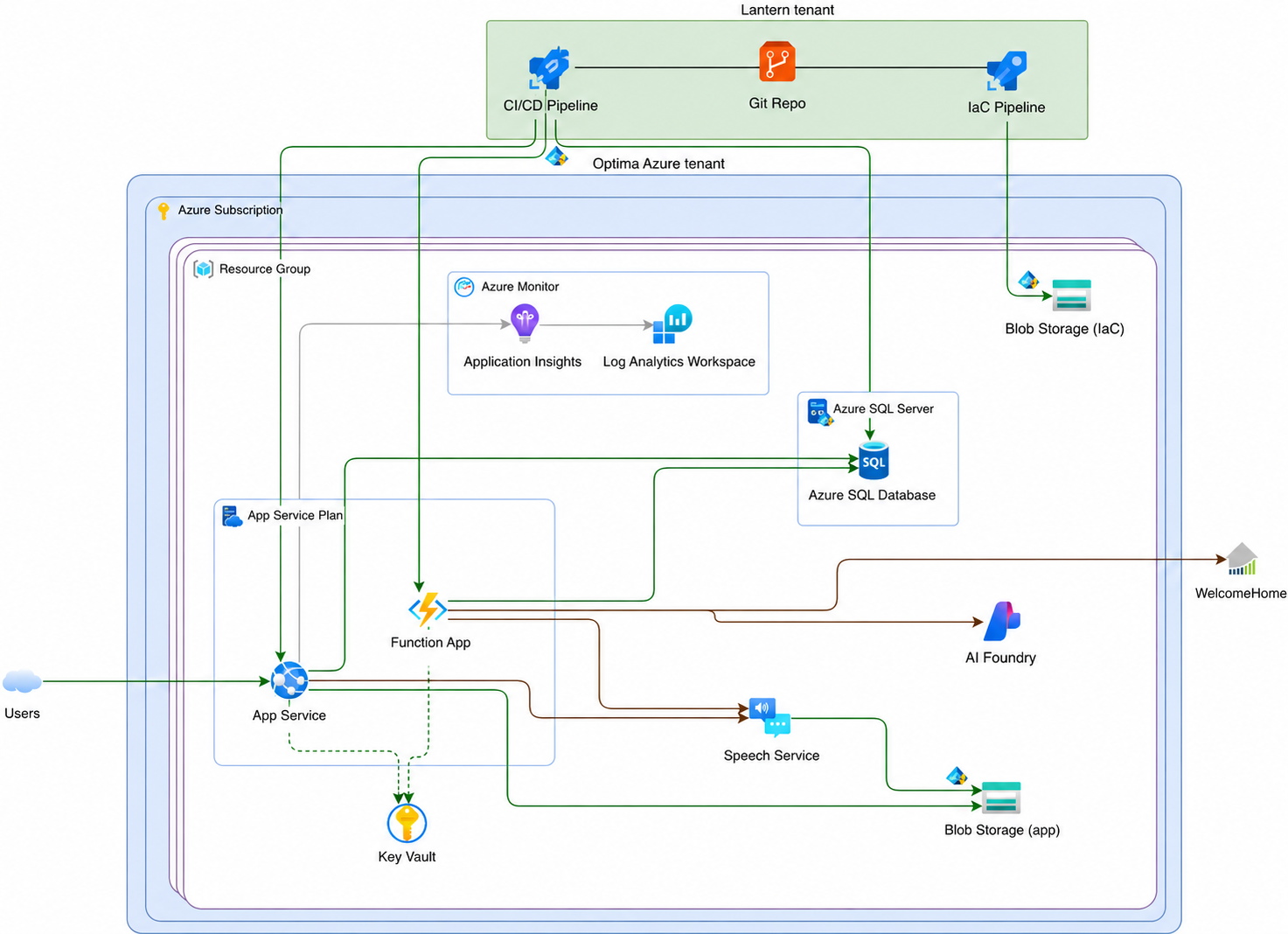
Lantern designed the Spark App to replace manual checklists and disconnected data sources with a dynamic, task-driven intake workflow. During family meetings, conversations are captured through voice recording, transcribed using Microsoft AI speech-to-text capabilities, and transformed by AI into a Living Story – a rich, narrative profile of the resident as a whole person, not just a diagnosis.
The Living Story gives every caregiver a complete, individualized picture of who the resident is. Their history, their relationships, their preferences, and their personality before day one. It doesn’t just inform care. It changes how care is given.
The solution integrates with Optima’s Welcome Home CRM and is secured through Microsoft Entra ID, creating a compliant, scalable foundation ready to extend across Optima’s full network of communities.
At Optima Living, we believe the future of dementia care lies at the intersection of human compassion and technological innovation. Through our partnership with Lantern, we are building SPARK—a new model of memory living and dementia support that uses AI to enrich the lives of people living with dementia while empowering families and caregivers with unprecedented support, insight, and connection. Together, we are demonstrating how technology can amplify humanity, preserve dignity, and unlock a future where every person affected by a brain health disease can live their best life.
- Farid Damji, Co-Founder and Principal, Optima Living
Delivering measurable impact with Microsoft AI
The Spark App demonstrates what Microsoft AI looks like when deployed with purpose in a high-stakes, human-centered environment. Key capabilities delivered include:
- Reduced administrative burden by replacing manual processes with an AI-enabled workflow
- Improved data accuracy and accessibility through centralized prospect information with seamless Welcome Home CRM integration
- Personalized care from day one with AI-generated Living Stories that inform individualized care plans before a resident arrives
- Built-in compliance and consent management supporting responsible data use in sensitive healthcare environments
- Microsoft AI capabilities proven in production with speech-to-text transcription, AI summarization, and narrative generation embedded in a mission-critical workflow
Most critically, the Spark App frees caregivers to do what no technology can replace: show up fully for residents and families in their most vulnerable moments.
Advancing Microsoft innovation through real-world application
Beyond its immediate impact, the Optima Living engagement highlights how Lantern brings Microsoft AI innovation to life in real-world, high-impact scenarios.
Through close collaboration with frontline healthcare teams, Lantern’s delivery model emphasized rapid learning, iterative development, and direct user engagement ensuring the technology solved meaningful, day-to-day challenges.
The Spark App also served as a proving ground for advanced AI capabilities, including speech-to-text transcription, AI-generated summaries, and narrative generation demonstrating how modern AI can be embedded into mission-critical workflows.
This hands-on innovation not only delivered value to Optima Living but also strengthened Lantern’s capabilities in applying Microsoft AI technologies to complex, human-centered use cases.
From pilot to platform: nearly $500k in grant pipeline built on partnership
What began as a targeted innovation initiative has evolved into a broader strategic partnership with significant future potential.
Optima Living has already secured $100,000 in grants through provincial government funding and is actively pursuing external funding (nearly $500,000 in grants) to expand the Spark platform. Together, Lantern and Optima Living are exploring how AI and data can measurably change outcomes for residents at every stage of their dementia journey, using technology to slow cognitive decline and improve quality of life in ways that go far beyond operational efficiency.
Looking ahead
Lantern and Optima Living are now building toward a long-term platform with the ambition to redefine how dementia care is delivered across Western Canada. With a growing pipeline of grant-supported innovation, an increasingly deep partnership, and Microsoft AI at the foundation, the Spark App is no longer a pilot – it is a blueprint.
This is what Lantern’s Do Good program was designed to prove: that technology applied with heart doesn’t just optimize processes. It changes lives. And when Microsoft AI is the engine, the scale of what’s possible is only just beginning to come into view.
Have a similar data problem in your organization?
Find out how our ideas and expertise can help you attain digital leadership with the Microsoft platform.

More Case Studies
Scaling GitHub Copilot Responsibly Across 21,000+ Developers at a Global Automotive Manufacturer
By implementing enterprise AI governance for GitHub Copilot, the organization improved spending visibility, strengthened accountability, and identified approximately $12.6 million in projected annual savings.
Industrial Automation Company Unlocks Customer Intelligence from Email with GenAI
By leveraging Generative AI, the organization transformed siloed email data into actionable customer intelligence, enabling greater visibility, improved efficiency, and more informed decision-making across teams.
Transforming Dementia Care with AI
Transformed dementia care intake with AI-generated resident profiles that enabled personalized care from day one.