
GitHub Advanced Security brings security closer to the code, the developer, and the moment a risk is introduced. The features matter. The operating model around them determines whether they produce durable risk reduction.
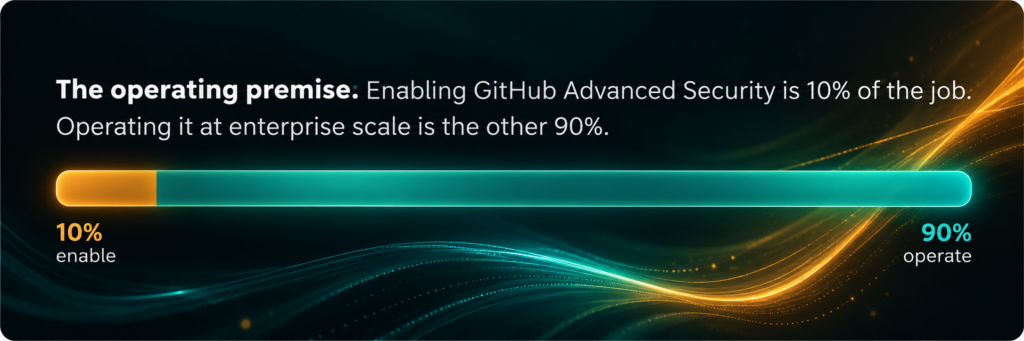
The 10/90 split is a practical heuristic, not a measured industry ratio. Its purpose is to reset the definition of “done.” Licenses, settings, and initial coverage are the opening move. The harder work begins when the features meet a living enterprise: thousands of repositories, uneven ownership, legacy code, unsupported build patterns, urgent delivery dates, and developers who need a useful answer when a control interrupts their work.
What GitHub Advanced Security Does
GitHub Advanced Security (GHAS) brings application-security capabilities into the workflows teams already use to build software. In this series, the focus is on these capabilities:
- Secret scanning detects credentials and other sensitive values that have been committed to repositories. For many supported providers, validity checks can help determine whether a detected secret is still active.
- Push protection acts earlier. It can block a supported secret before it is pushed, giving the developer a chance to remove it or use an approved bypass path.
- Code scanning analyzes code for vulnerabilities and coding errors. It can surface findings in the repository and in pull-request workflows, where teams can address issues before they reach production.
- Dependabot addresses the supply-chain side, opening pull requests that update vulnerable dependencies.
Each capability solves a different problem. Secret scanning finds exposure that already exists. Push protection prevents new exposure. Code scanning identifies vulnerable patterns in code and create a path to remediation. Together, they move security from periodic review to an ongoing part of software delivery.
For readers outside the security function, the business translation matters more than the mechanism. Secret scanning and push protection reduce organizational risk in its most expensive form: a leaked production credential is not a vulnerability, it is a potential breach. Every blocked push is an incident that never happened, and the same telemetry becomes audit readiness — blocked pushes and validated secrets are demonstrable controls. Code scanning compresses remediation time by moving findings into the pull request, where the fix is cheapest, and it protects developer productivity: fewer emergency rotations, less rework, less context-switching into security tickets months after the code was written. Across these capabilities, the compound outcome is engineering confidence — the ability to ship at speed without wondering what is exposed.
The 10% is real work, but it is bounded
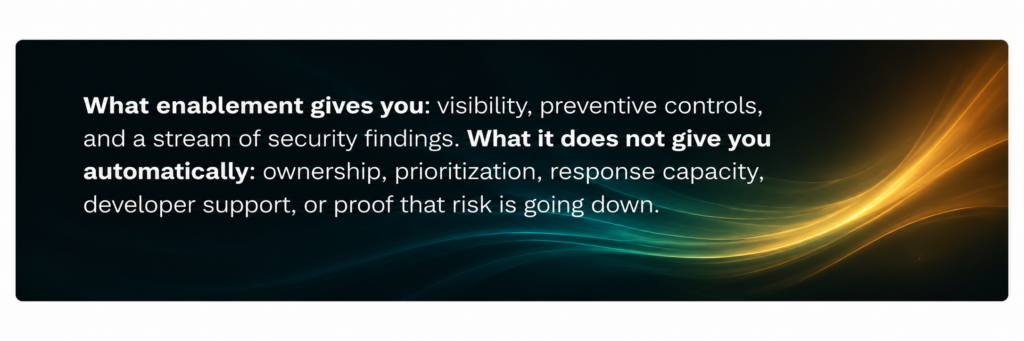
The enablement layer includes licensing, security configurations, organization settings, repository coverage, code-scanning setup, and initial reporting. GitHub has made much of it increasingly manageable at scale. Organization-level defaults establish a baseline; automation brings large groups of repositories under scanning; central reporting shows where coverage exists and where it does not.
That work is valuable. It simply does not answer the operating questions that appear next:
- Who validates an unknown secret and determines what it can access?
- Who owns a code-scanning alert when repository ownership is unclear?
- What happens when a developer is blocked after normal support hours?
- When is a push-protection bypass legitimate, and who reviews it?
- How old can a critical alert become before leadership intervenes?
- How should a business-critical service differ from an archived sandbox?
A program can show impressive coverage and still fail every one of those tests. Configuration creates reach. An operating model converts that reach into action.
The 90% is the system around the features
At enterprise scale, the remaining work tends to fall into five connected disciplines.
Organizations rarely struggle with enabling a feature. They struggle with scaling a behavior. The same pattern appears in platform engineering, AI adoption, and security modernization: the technical implementation is often the fastest part. Durable value is created by the operating model around it – clear ownership, predictable cadence, useful answers at the point of friction. We’ve seen this arc with Copilot at scale, where the license is the easy part and the operating model is the actual product.
- Rollout without avoidable disruption. Code scanning and push protection need different rollout paths. Teams need reliable workflows, clear communications, staffed support, and a usable escalation route before broad enforcement.
- Triage that survives contact with the estate. Repository names and alert age are convenient fields, not sufficient risk signals. Secret-scanning triage needs validity and blast radius. Code-scanning triage needs severity, exploitability, reach, business context, and backlog thresholds.
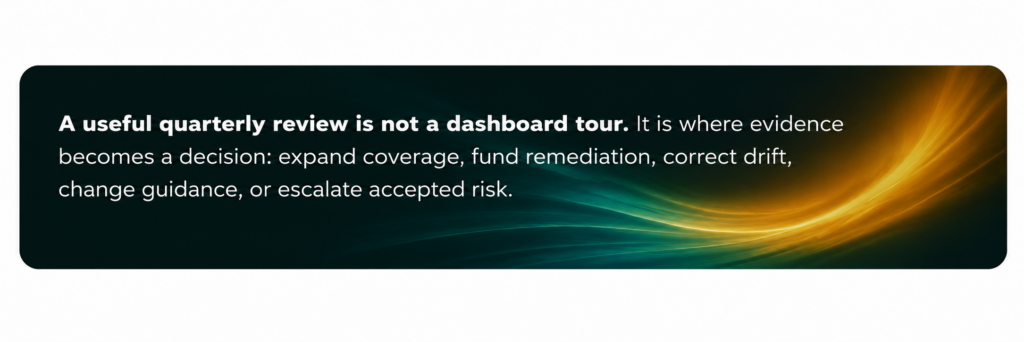
- A quarterly operating cadence. A named security owner should bring coverage, backlog health, remediation performance, bypass trends, configuration drift, and exceptions into a decision forum. Every material finding should leave with an owner and a date.
- Maturity shaped by business context. Technical readiness and business impact are different dimensions. A repository may be easy to scan but costly to disrupt; a sandbox may still contain a credential with production access. Classification should shape the rollout and support path, never erase a real risk.
- Remediation capacity that can keep up. Human-only remediation rarely scales to the initial backlog and ongoing alert flow. Automation and AI can remove toil, provided review and accountability remain explicit.
This is also why developer experience is part of the control. A short, blame-free guide for a blocked push can beat a long policy document nobody can use in the moment. The secure action should be the fastest understandable action.
The agentic future expands capacity, not authority
Traditional remediation depends on security teams and developers manually working alert backlogs. At enterprise scale, those economics quickly break down: the backlog grows faster than the team, triage becomes the work instead of the fix, and the oldest alerts quietly become accepted risk. This is where AI begins to change the equation – not by replacing judgment, but by removing the toil that consumes it.
AI can help close the gap between how fast scanning finds vulnerabilities and how fast teams fix them. Straightforward findings may begin with Copilot Autofix. More complex issues suit a bounded agentic workflow that investigates across files, follows repository conventions, runs tests, and prepares a pull request.
The boundary matters. AI can investigate, propose, edit, and test. It should not approve its own work, accept residual risk, or bypass a control. Human reviewers retain security judgment, functional accountability, and the merge decision.
AI does the toil. Humans keep the judgment.
Where this series goes next
The next three posts turn the 90% into practical operating disciplines:
- Code scanning at enterprise scale: policy defaults, repository onboarding, query-suite choices, pull-request enforcement, triage, and backlog health.
- Secret scanning at enterprise scale: the backlog ambush, validity and blast radius, push-protection rollout, bypass governance, and developer trust.
- Agentic remediation: using AI across the upfront code-scanning backlog and ongoing maintenance without giving up accountable control.
GitHub Advanced Security becomes valuable when an organization can keep coverage current, route risk to an owner, support developers at the point of friction, and turn findings into reviewed fixes. If your organization is ready to move from feature enablement to an operating capability, reach out to Lantern.
Platform references: Enabling security features at scale and Security overview.