
Here’s a myth worth busting up front: Microsoft Fabric’s pricing model isn’t the problem. It’s actually one of the more predictable things about the platform.
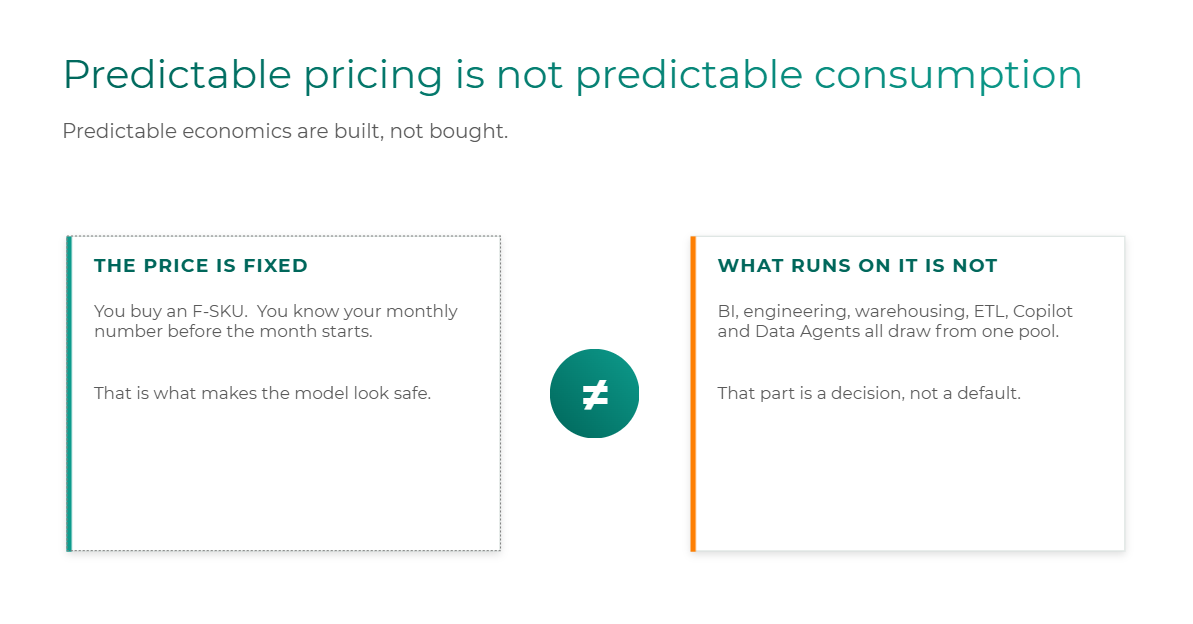
You buy an F-SKU. You know your monthly number before the month even starts. No usage-based line items to reconcile, no surprise per-query charges. On paper, that’s exactly what a finance team wants from a platform commitment. To be fair to Microsoft Fabric, that part of the promise holds up.
So why do so many organizations still end up blindsided by their Fabric costs?
Because predictable pricing and predictable consumption are two completely different things, and Fabric only guarantees the first one.
The part nobody budgets for
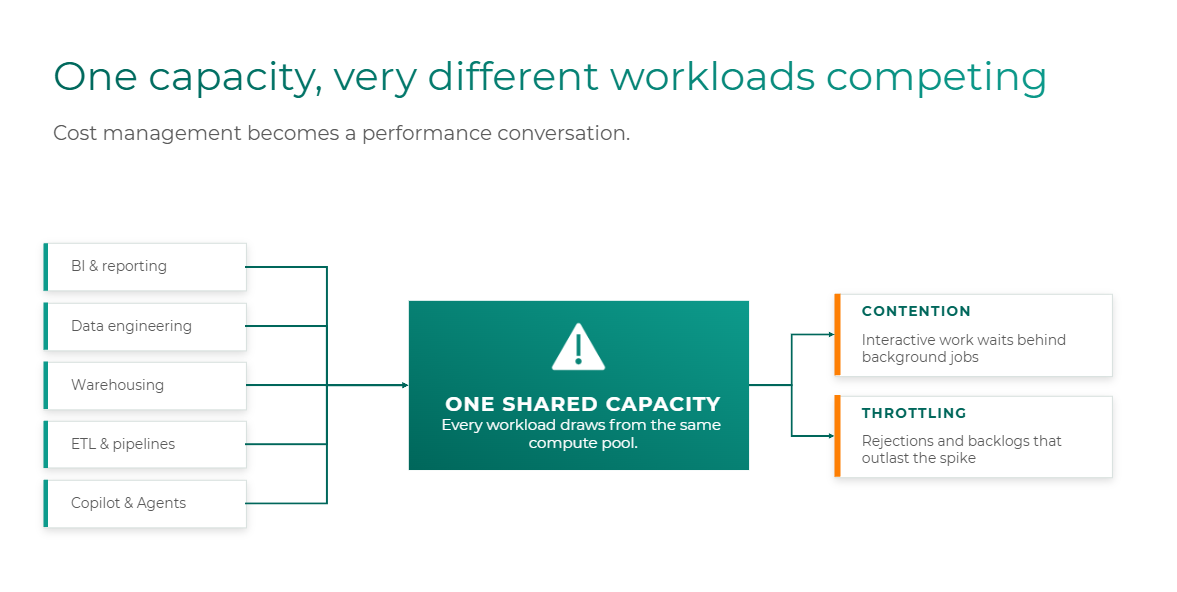
The price of your capacity is fixed. What runs on top of that capacity is not. BI reporting, data engineering, warehousing, ETL pipelines, Copilot, and Data Agents can all draw from the exact same shared pool. Whether they should share that pool, and how much room each one gets, isn’t something Fabric decides for you. It’s a decision your organization has to make on purpose.
Most organizations don’t make it on purpose. It just happens by default, one workload at a time.
How it actually plays out
The pattern is remarkably consistent across the customers we talk to:
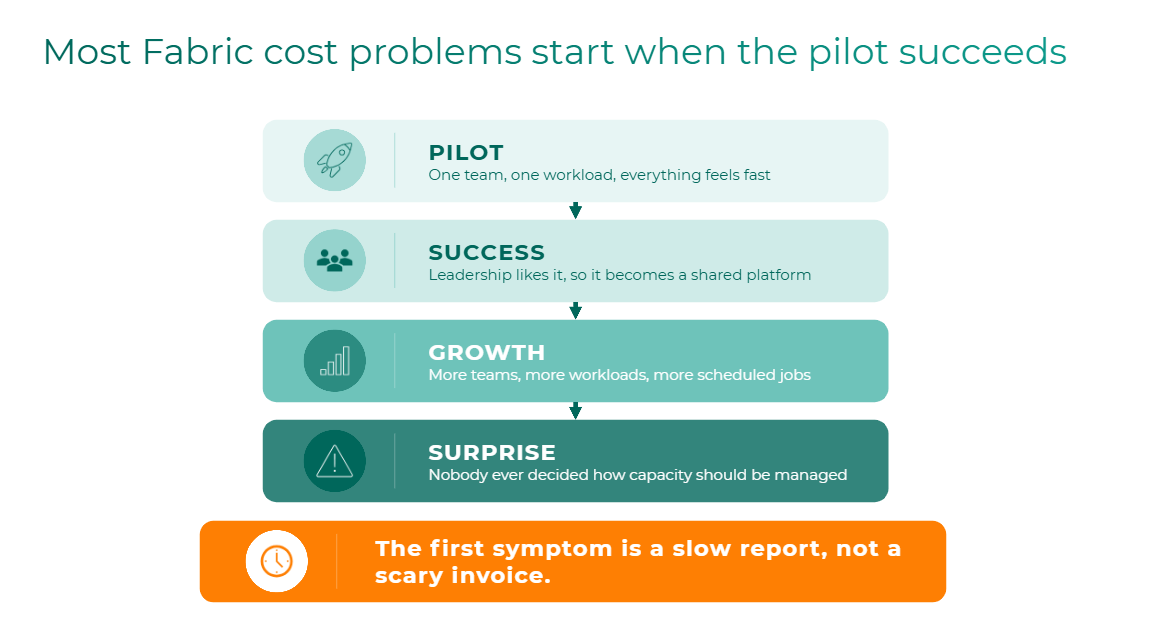
A pilot launches with one team and one workload. It runs great. Fast, responsive, no complaints. Leadership likes what they see, so it graduates into a shared production platform.
- More teams get added.
- More workloads land on it.
And somewhere in that growth, nobody ever explicitly decided how the shared capacity should be managed. It just accumulates.
Here’s the part that catches people off guard: the first symptom usually isn’t a scary invoice. It’s a report that used to load in two seconds now taking twenty. It’s a refresh that used to finish overnight now bleeding into the workday.
Why this becomes everyone’s problem, not just IT’s
Once workloads start competing for the same cycles, cost management quietly stops being a billing conversation and becomes a performance and adoption conversation.
The business doesn’t experience this as “we have a capacity smoothing issue.” They experience it as “Fabric is slow” or “the Copilot stuff isn’t working.” And now what started as a technical footnote is an adoption problem, the kind that shows up in a leadership meeting, not a monitoring dashboard.
The reframe
Fabric can absolutely deliver predictable platform economics. That promise is real. But predictability doesn’t happen automatically just because the price is fixed. It has to be built, through an intentional practice for how capacity gets sized, monitored, organized, and governed as adoption grows.
The SKU price is fixed. What runs on it is not. Everything else follows from that one distinction.
This is the first post in a series unpacking the Fabric FinOps playbook from our recent webinar with Microsoft. Next up: the three decisions that actually determine your Fabric bill and why most organizations are only making one of them on purpose.
Watch the full webinar: Control Microsoft Fabric Costs: A FinOps Playbook for Capacity and Throttling — on demand now.