
Last week I read a thoughtful piece titled “The Vibes Are Off”, which captured something developers everywhere have been feeling: the initial magic of prompting AI tools to “write some code” is starting to fade. Vibe-driven coding — typing a vague description into a chat box and hoping for the best — works for small prototypes and quick experiments. But in enterprise codebases with constraints, dependencies, security policies, and CI/CD pipelines, it collapses quickly.
The shift is clear: developers don’t need better vibes. They need agentic systems that understand intent, plan work, execute tasks, test outcomes, and improve over time—all while fitting into real modern software engineering workflows.
As someone working deeply in the GitHub and Microsoft ecosystem, I believe we’re entering the first phase of true agentic development. Teams that embrace this shift deliberately, with the right platforms and guardrails, will move faster than any “just prompt it” workflow could deliver.
Why Vibe Coding Hits a Ceiling
Prompting alone lacks architectural consistency, maintainability, and integration with essential workflows like pull requests, CI/CD, and version control. It doesn’t create reusable components, testable systems, observability, governance, compliance, security, or accountability.
For quick experimentation, vibe coding feels effortless. At scale, it becomes a liability. We’ve reached the ceiling of what unstructured AI assistance can do.
What Agentic Development Actually Means
Agentic development isn’t “AI that writes more code.” It’s AI that does the work – planning, execution, testing, and iteration – while staying grounded in the tools engineers already use.
A true agent doesn’t just generate output. It:
- Decomposes tasks into actionable steps.
- Executes within existing codebases and workflows.
- Adjusts based on test results and feedback.
- Follows rules, guardrails, and security policies.
- Uses tools, calls APIs, and integrates with systems.
- Opens pull requests and waits for human review
- Understands that delivering software differs from generating text
The Platform: Two Pillars
We’re building the agentic future on two platforms that work together.
GitHub Copilot Agent Mode
The first mainstream implementation of agentic development, embedded directly in the development platform:
- Reads and interprets full repositories
- Plans multi-step tasks and executes changes in branches
- Opens pull requests and runs tests
- Integrates with GitHub Actions
- Respects security reviews and governance through GitHub Advanced Security (GHAS)
Azure AI Foundry
The enterprise platform for building, evaluating, governing, and deploying custom AI agents:
- Model catalog and orchestration
- Data and context management
- Safety guardrails and continuous evaluation
- Monitoring and compliance enforcement
- Integration with GitHub, Azure DevOps, and custom tools
GitHub serves as the execution environment for agentic work. Azure AI Foundry is the brain factory where teams design custom agents, chain them with tools, and enforce safety policies. Together, they form the first complete agentic development stack for enterprises.
Five Core Capabilities
Agentic systems operate through specific capabilities:
- Goal Decomposition: You provide a high-level objective (“migrate this API to the new framework”) and the agent breaks it into actionable steps – identifying dependencies, planning the sequence, and determining what needs testing.
- Contextual Execution: Agents work directly inside codebases with full context repository context, working with branches, commits, and PRs just as developers do.
- Continuous Evaluation: Agents assess their own outputs using tests, linters, GHAS scanning, telemetry, and feedback loops. They don’t just generate code – they validate it.
- Autonomous Iteration: When tests fail, agents fix them. When refactoring is incomplete, agents continue. They operate in loops, not single-shot generation.
- Governance by Default: Agents operate inside established guardrails, leveraging pull requests, code reviews, GHAS security scanning, branch protections. Safety is built into the workflow.
What Changes for Developers
Agentic tools don’t remove developers – they elevate them. Instead of manually writing boilerplate code, migration scripts, or test scaffolding, developers focus on:
- Intent and architecture
- API design and system patterns
- Consistency across the codebase
- Reviewing agent output
- Managing risk and ensuring quality
- Making strategic technical choices
Developer time shifts from typing code to designing outcomes – where high-impact engineering has always lived.
The Agentic Stack
A modern agentic environment connects five layers: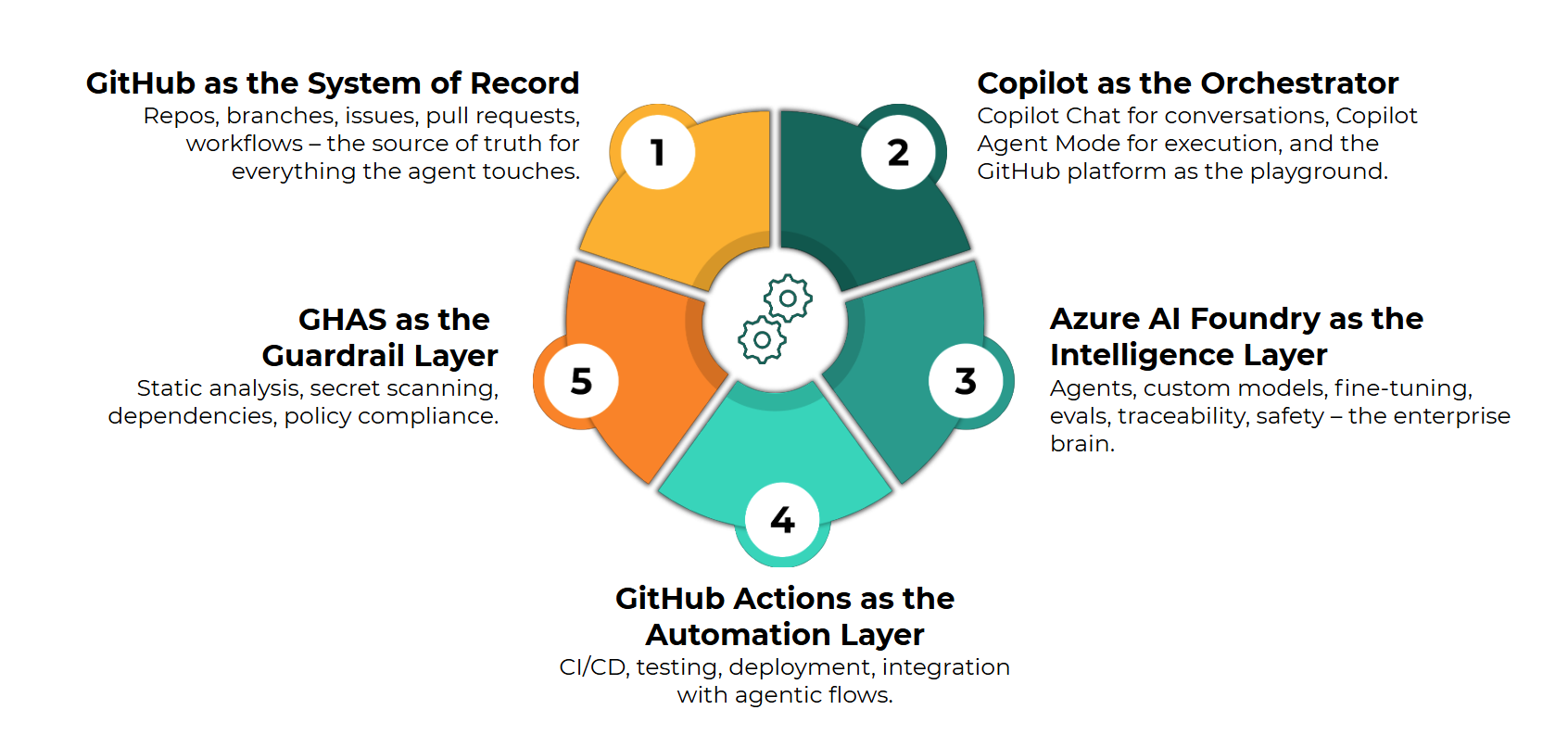 Everything connects within structured engineering discipline, replacing ad hoc workflows.
Maturity Stages
Organizations typically fall into one of three stages:
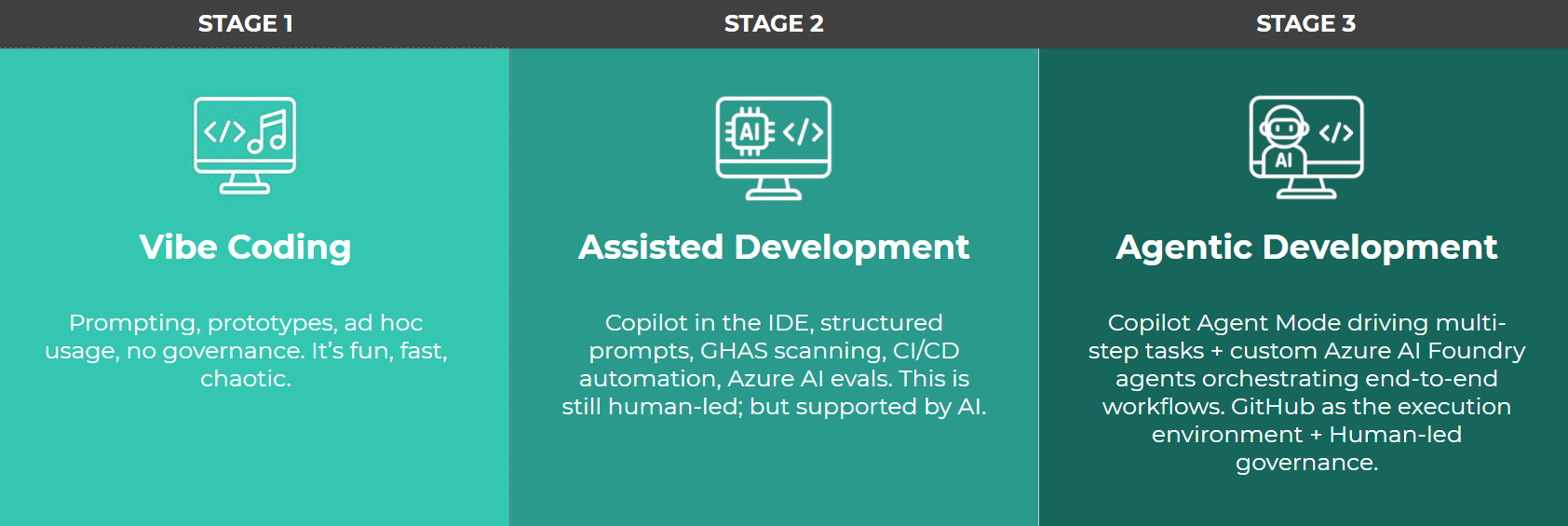 This is where Innovation Velocity compounds, engineering productivity leaps forward, and teams outperform competitors.
Real-World Applications
Agentic development is already handling tasks enterprises need:
- Massive refactoring across large repositories
- Automated test generation, repair, and expansion
- Dependency updates and vulnerability remediations
- API migration (e.g., .NET Framework → .NET 8)
- Codebase modernization at scale
- Documentation alignment and consistency
- Performance tuning and observability improvements
Guardrails Matter
Agentic development is powerful, but it requires discipline through guardrails and security policies, continuous model evaluation, mandatory human oversight, clear escalation paths, and enterprise safety frameworks.
GitHub and Azure are uniquely positioned because governance is built in. The workflows already exist. The safety nets are first-class.
The Next 3-5 Years
We won’t talk about vibe coding. We’ll see:
- Multi-agent systems coordinating entire features
- Autonomous CI/CD and remediation pipelines
- Repo-to-repo orchestration across microservices
- Agents refactoring legacy systems without manual effort
- Developers focusing on architecture and strategy
- GitHub as the operating system for software engineering
- Azure as the enterprise agent compute layer.
Conclusion: From Vibes to Velocity
Vibe coding was a necessary first step that showed us what AI could do. Agentic development shows us what AI will do.
Teams who invest in agentic workflows today — with GitHub Copilot, Azure AI Foundry, GHAS, GitHub Actions, and the full Microsoft ecosystem — will unlock developer velocity that simply isn’t possible in vibe-driven workflows.
The future is agentic, structured, and collaborative. And it’s arriving now.