
Every executive investing in AI faces the same uncomfortable question: Are we actually getting returns, or just burning budget on the latest trend?
The answer, according to new research from IDC surveying over 4,000 business and IT leaders across 16 countries, is yes. AI is delivering returns.
But there’s a critical caveat that should concern every organization still on the sidelines: the returns are not evenly distributed.
A new class of organization has emerged, what researchers call “Frontier Firms”, representing the top 22% of companies leading the AI revolution. These organizations aren’t just experimenting with AI; they’re operationalizing it at scale and seeing dramatically different results than everyone else.
The ROI Gap: A Tale of Two Outcomes
The data paints a stark picture. Frontier Firms are achieving a 2.84x return on investment on their AI spend. Laggards? They’re seeing just 0.84x, effectively losing money on their current initiatives.
This isn’t a marginal difference. It’s a chasm.
What makes this gap even more alarming is the operational divide behind it. 98% of Frontier Firms are already operational with GenAI, actively deploying it across their organizations. Compare that to just 31% of laggards. Even more telling: 65% of laggards are still stuck in the “planning” phase, watching from the sidelines while leaders pull further ahead.
The business impact extends far beyond financial returns. When asked about AI’s effect on critical business metrics, the gap between leaders and laggards is consistently 4x:
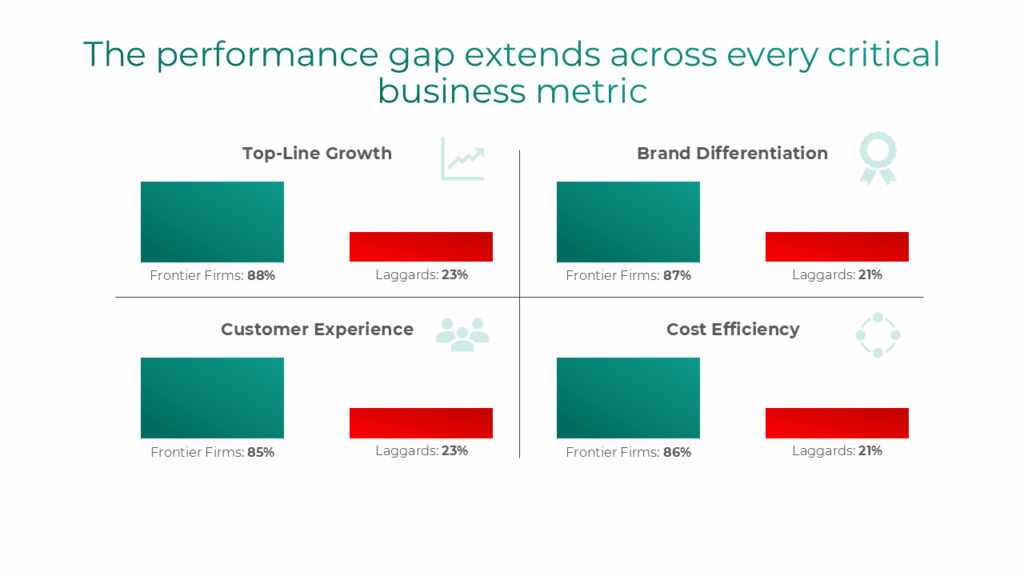
These numbers represent organizations reporting significant positive impact in each area. Laggards most often respond “not applicable”—signaling little measurable impact at all.
The Reality Check: Why Average ROI Has Dipped
Before you assume the path to Frontier Firm status is quick and easy, here’s an important reality check. The average ROI for GenAI users is 2.8x, which is strong, but actually down from 3.7x reported in 2024.
Why the dip? It’s not a sign of failure. It’s a sign of maturity.
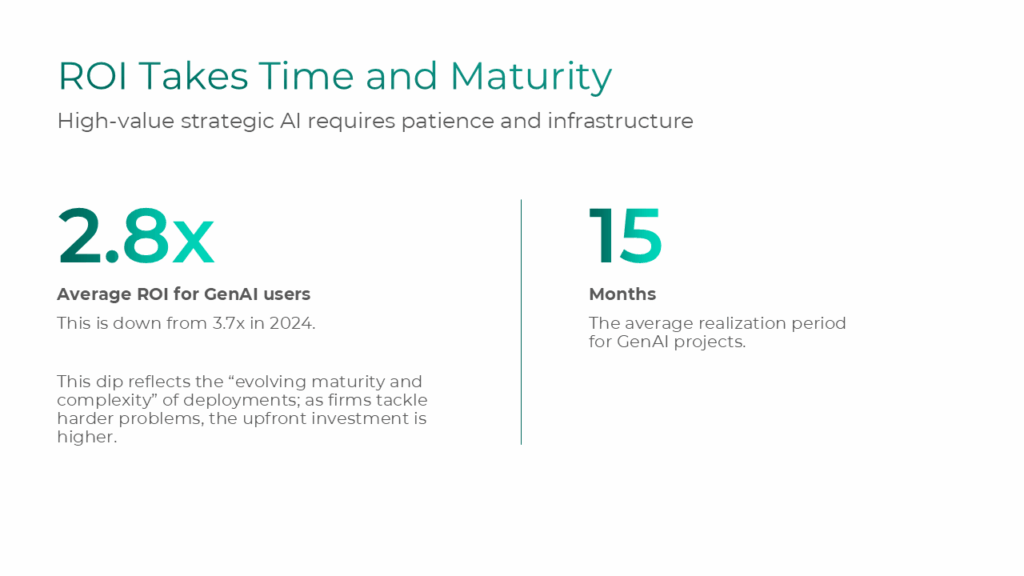
Organizations are tackling harder problems now. The easy wins from basic productivity improvements have been captured. Leaders are now investing in more complex, strategic AI implementations that require significant upfront investment in infrastructure, data quality, and change management.
The average time to realize significant returns is 15 months. This isn’t a technology you deploy in Q1 and measure ROI in Q2. Executives need to prepare stakeholders for a 13-15 month curve to see meaningful returns on complex AI infrastructure investments.
What Frontier Firms Do Differently
So what separates the 22% achieving nearly 3x returns from everyone else? The research reveals three fundamental differences in how Frontier Firms approach AI.
Shift #1: Beyond Productivity to Strategic Use Cases
Early AI adoption focused almost exclusively on individual employee productivity; summarizing documents faster, drafting emails, automating routine tasks. This is now table stakes.
Frontier Firms have moved beyond productivity to pursue functional and industry-specific use cases that drive top-line revenue:
- Productivity use cases: Reducing time spent analyzing or completing tasks
- Functional use cases: Transforming business functions like marketing, sales, IT, and supply logistics
- Industry use cases: Creating new business models, products, or services specific to their sector
The difference? Frontier Firms have adopted functional and industry use cases at nearly twice the rate of their peers. Leaders are using AI to reimagine how entire business functions operate.
Shift #2: From Pre-Built to Customized Solutions
Today, 40% of organizations are using pre-built GenAI applications. That’s a reasonable starting point. But here’s where leaders separate themselves: 70% of organizations plan to move to customized or custom-built solutions within 24 months.
Frontier Firms aren’t waiting. 58% already use customized AI solutions today.
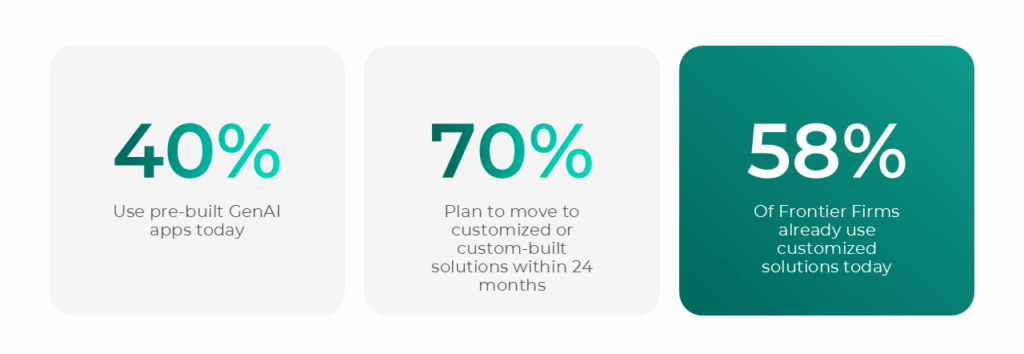
The logic is straightforward: generic models trained on generic data produce generic results. Your competitive moat isn’t built on the same AI tools your competitors are using—it’s built on how you customize those tools with your proprietary data, processes, and domain expertise.
Shift #3: Enterprise-Wide, Not Siloed
Here’s perhaps the starkest finding in the research: 97% of Frontier Firms use GenAI in two or more business functions. For laggards? Just 18%.
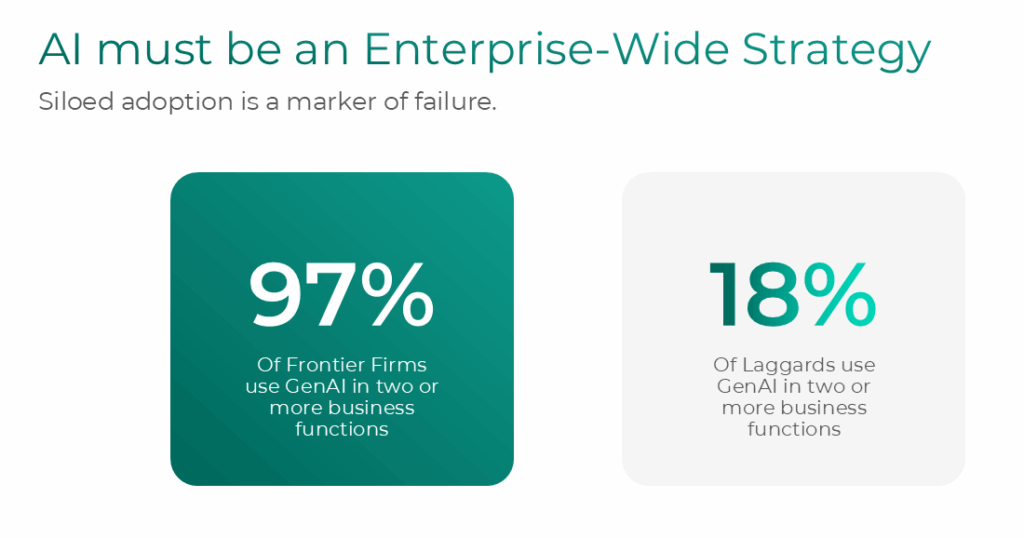
Frontier Firms use GenAI across an average of seven distinct business functions, while laggards typically deploy it in isolation. If AI is only running in IT, or only in marketing, you’re leaving value on the table.
Siloed adoption isn’t just inefficient; it’s a marker of failure. The research makes clear that cross-functional deployment, with shared budget and strategy between lines of business and IT, is essential for realizing AI’s full potential.
The Agentic AI Opportunity
The next frontier is already here: Agentic AI—systems that can reason, plan, and execute multi-step tasks with minimal human intervention.
The adoption curve is accelerating rapidly:
- 37% of organizations are already using Agentic AI
- 25% are actively experimenting
- 24% plan to deploy within 24 months
Even in pilot stages, Agentic AI is already delivering a 2.3x ROI. As these implementations mature and scale, returns are expected to grow significantly.
For executives looking to identify quick wins, the research points to high-volume transaction areas like customer service or IT operations where Frontier Firms are already seeing strong returns from agentic deployments.
Funding and Governance: Enabling Scale
Understanding what to do is only half the battle. Leaders must also address how to fund and govern AI initiatives for sustainable scale.
The Funding Imperative
One of the biggest mistakes organizations make is trying to fund AI innovation from existing IT budgets. This forces AI to compete with keeping the lights on—and innovation loses every time.
The data shows a different approach among leaders:
- 40% of organizations are increasing AI spending by up to 19%
- 34% are adding net new investment rather than cannibalizing existing budgets
- 44% of AI budgets are now influenced or owned by business functions, not just IT
Governance as Accelerator
Here’s a common misconception worth challenging – governance is not about slowing down innovation. It’s about enabling scale.
The top challenges organizations face when trying to scale AI are security, privacy, and governance. You cannot scale what you cannot control.
Currently:
- 46% of organizations have an AI governance body
- But only 38% have the technical tools to actually enforce their policies
This isn’t about limiting AI; it’s about building the trust required to deploy it at scale. Frontier Firms recognize these risks more profoundly than most, and they’re proactively investing in responsible safeguards and governance frameworks that enable them to continue innovating with confidence.
The Cost of Waiting
Let’s return to those business metrics one more time; not because the numbers have changed, but because the implications have.
The gap between Frontier Firms and laggards—88% vs. 23% on top-line growth, 87% vs. 21% on brand differentiation—isn’t static. It’s widening.
Every quarter an organization waits, the cost of catching up increases. The leaders aren’t standing still; they’re accelerating. The middle ground is disappearing.
The Choice Every Organization Faces
Think of it this way: Laggards are putting fresh paint on the same old structure. They’re optimizing, rebranding, making incremental improvements—but the underlying architecture hasn’t changed.
Frontier Firms are rewiring the building. Yes, it costs more. Yes, it takes longer. But once finished, the building functions in a completely new, automated way that the repainted building never will.
The research is unambiguous: AI is no longer experimental. It’s essential. Organizations that remain in the planning phase risk falling behind in brand differentiation, customer experience, cost efficiency, and growth.
The question isn’t whether to invest in AI. It’s whether you’re ready to invest like a Frontier Firm—with the scale, customization, cross-functional deployment, and governance required to actually see returns.
Where does your organization fall on this spectrum? And more importantly, what are you going to do about it?
Data and insights in this article are drawn from IDC’s Business Opportunity of AI Survey (August 2025), which surveyed over 4,000 business and IT leaders across 16 countries responsible for GenAI decision-making at organizations with 1,000+ employees.