Industry
Services
Impact
Executive Summary
When a leading Canadian engineering and construction firm decided to explore AI adoption, their VP of IT understood a fundamental truth: successful AI transformation requires organizational buy-in. Rather than imposing a top-down strategy, he chose to bring together a cross-functional AI Working Group to collaboratively envision the company’s AI future. Lantern designed and facilitated a two-day AI Envisioning Workshop that transformed 50+ initial ideas into three actionable, prioritized use cases—complete with detailed business case foundations. The VP presented the outcomes to the board just two days after the workshop concluded, receiving strong support for the proposed AI initiatives.
The Challenge
The engineering and construction firm was at an inflection point in their technology journey – they recognized the transformative potential of AI but needed to approach adoption thoughtfully.
- The industry overall was ripe for AI and digitalization, but the organization had just barely dipped their toe into AI technologies. While they had some technical debt, they weren’t encumbered by legacy systems that would complicate AI deployment.
- The VP of IT recognized that driving an AI agenda organically—with employee ownership of the vision—would be far more effective than a top-down mandate.
- The organization needed to open the AI conversation with a diverse group of stakeholders, get everyone aligned on possibilities, and narrow down to specific, actionable initiatives—all while building the cross-functional relationships that would sustain AI adoption long-term.
The organization needed a partner who could design an engaging, collaborative experience that would harness the collective wisdom of their people, generate genuine buy-in, and produce concrete outputs ready for executive action.
The Solution: A Human-Centered Workshop Approach
Phase 1: Collaborative Design and Preparation
Lantern invested significant effort in understanding the client and designing a workshop that would achieve both explicit and implicit objectives. Weekly meetings with the VP of IT over eight weeks established rapport, clarified expectations, and built confidence in the approach.
The design process involved approximately 40 hours of preparation per day of workshop—a substantial investment that would prove essential to the outcomes achieved. Key preparation activities included:
- Participant Analysis: Understanding the AI Working Group’s composition—intentionally diverse across business functions, seniority levels, and tenure. The group included representatives from marketing, data, social media, and core engineering functions, ranging from junior employees to partners with decades of experience.
- Pre-Read Materials: A comprehensive packet including industry trends, competitive landscape analysis, and AI best practices to ensure participants arrived with informed perspectives.
- Pre-Workshop Survey: Participants were invited to submit AI use case ideas before the workshop. The response exceeded expectations—from 13-14 participants, 27 potential use cases were submitted, signaling high engagement and readiness.
- Kickoff Meeting: A virtual session one week before the workshop to set expectations, review logistics, and begin opening the conversation about AI possibilities.
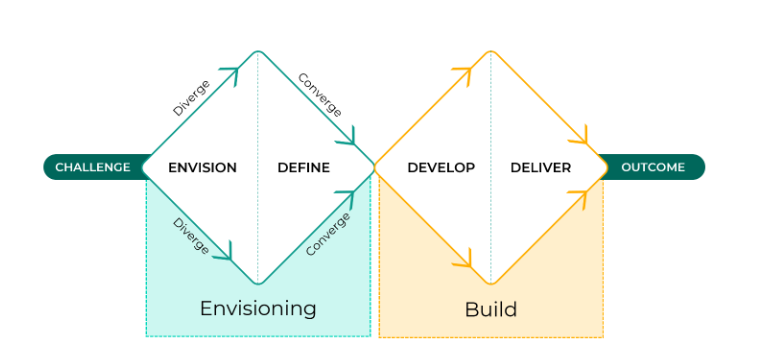
The workshop design followed human performance design principles—a “diamond” methodology of expanding ideas then converging on solutions, repeated iteratively to drive synthesis and refinement while maintaining participant investment in outcomes.
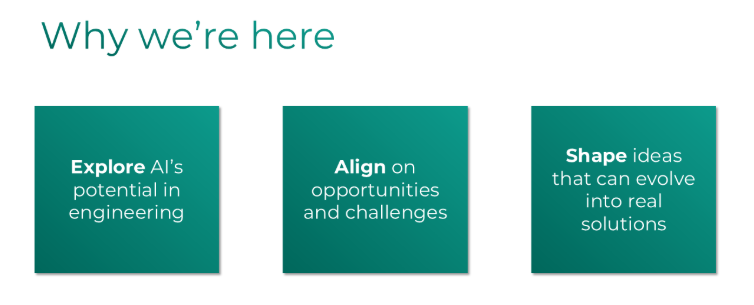
Phase 2: The Two-Day Workshop
Day One: Expanding Possibilities
The first day focused on opening the conversation, building team cohesion, and generating a comprehensive view of AI opportunities. Key activities included:
- Visioning Exercises: Participants explored questions like “How do you imagine the company in 12 months using AI?” and “What’s one risk of moving too slowly or too quickly?” These discussions established shared context and surfaced diverse perspectives.
- Mission Statement Development: The group collaboratively defined an AI mission statement and guidelines—an exercise designed to align mindsets before diving into solutions.
- Rose-Bud-Thorn Analysis: A structured exercise to identify opportunities (roses), potential (buds), and challenges (thorns) across the business, generating over 50 different ideas.
- Criteria Definition: Early in the process, participants established their own criteria for evaluating ideas – creating a touchstone they would return to throughout the workshop for decision-making.
- Opportunity Statements: Ideas were refined into structured statements covering the problem, concept, and value proposition, ready for deeper exploration on Day Two.
Throughout the day, facilitators varied group compositions—individual work, pairs, small teams, and full group discussions—to maximize diversity of thinking and build connections between participants who had never worked together in person before.
Day Two: Converging on Action
The second day transformed broad opportunities into detailed, actionable use cases:
- Use Case Canvas Development: Teams developed comprehensive canvases for priority ideas, covering feasibility, readiness, data requirements, systems and tools, process impact, people implications, and risks.
- Pitch Sessions: Groups of three to four participants pitched their use cases to the full room, fielding questions and challenges. This pressure-testing added final layers of sophistication and surfaced unconsidered factors.
- Impact-Feasibility Mapping: All refined use cases were plotted on an impact and feasibility matrix. After initial placement, participants spent 20 minutes discussing and adjusting positions—creating shared understanding of relative priorities.
- Dot Voting: The group used dot voting to prioritize the top use cases for immediate action, while preserving all other ideas for future phases.
Phase 3: Rapid Synthesis and Delivery
- The workshop concluded at 2:30 PM on Wednesday.
- By Thursday evening, Lantern had synthesized all outputs into professional deliverables.
- On Friday, the VP presented to the board.
The rapid turnaround required immediate post-workshop documentation, synthesis of themes and patterns from all activities, transformation of workshop artifacts into polished use-case descriptions, and creation of board-ready materials that reflected the rigor and depth of the collaborative process.
The Impact
The workshop delivered concrete, measurable outcomes:
- Three Prioritized Use Cases: From 50+ initial ideas, the group converged on three high-impact, high-feasibility use cases with detailed documentation including business rationale, AI enablement approach, industry context, and implementation considerations.
- Business Case Foundations: Each use case included preliminary analysis of people impact, process changes, and financial implications—far beyond simple one-sentence descriptions.
- Key Themes Analysis: A synthesized view of patterns and themes that emerged across all workshop activities, providing strategic context for the prioritized initiatives.
- Successful Board Presentation: The VP presented to the board two days after the workshop concluded, receiving positive feedback and support for incorporating the AI initiatives into FY strategy and investment planning.
- Preserved Innovation Pipeline: All ideas that weren’t immediately prioritized were captured and categorized, ensuring no insights were lost and providing a roadmap for future AI initiatives.
Beyond the tangible deliverables, the workshop achieved equally important intangible outcomes. As one facilitator observed: “As they were leaving the room, the conversations were continuing. They were talking not only about the use cases, they were talking to each other about how they could help each other. ‘I didn’t realize this. You know what? Let’s meet on Monday to talk about that.’ In terms of storming, forming, norming—we’ve really gone through that process, which really will set up the group going forward. They are now a unit.”
Key Success Factors
Reflecting on what made this workshop successful reveals critical lessons for organizations embarking on AI strategy:
- Organic Ownership: The VP recognized that making AI adoption “their conversation and their vision” would generate far more sustainable commitment than top-down mandates. The workshop was designed to put participants in the driver’s seat.
- Intentional Diversity: The AI Working Group was deliberately composed of people from different functions, seniority levels, and tenure lengths—maximizing perspective diversity and ensuring broad organizational representation.
- Thorough Preparation: Weeks of collaborative design, pre-read materials, idea solicitation, and kickoff meetings ensured participants arrived informed, engaged, and ready to contribute meaningfully.
- Iterative Refinement: The diamond methodology—expanding possibilities then converging on priorities—was applied repeatedly. Ideas went from 50+ to 15 to 9 to 6 to 3, with each iteration adding depth and detail.
- Rapid Delivery: Professional documentation delivered within 24 hours enabled the VP to present to the board immediately, maintaining momentum and capitalizing on fresh enthusiasm.
Conclusion
The AI Strategy Workshop succeeded because it recognized that AI transformation is ultimately about people and organizational change, not just technology selection. By creating space for diverse voices, building genuine ownership of the AI vision, and producing actionable outputs ready for executive decision-making, the engagement delivered value far beyond a typical strategy exercise.
For organizations considering AI adoption, this engagement offers a proven approach: invest in collaborative design, engage stakeholders as partners rather than audiences, use structured methodologies that balance creativity with convergence, and move rapidly from workshop to action. The result isn’t just an AI strategy—it’s organizational alignment that positions the entire company for successful AI transformation.
Have a similar data problem in your organization?
Find out how our ideas and expertise can help you attain digital leadership with the Microsoft platform.