
Many organizations measure GitHub Copilot success by how much code it generates. That’s the wrong question.
The real question is whether you’re building the right code and whether it’s improving outcomes that matter to your business. More code is being generated, sure. But is the right code being generated? Are we completing more user stories? Is our security posture improving? These are the questions I hear from engineering leaders every week.
Without meaningful metrics, pilots stall and leadership loses confidence. Organizations that scale Copilot successfully measure three tiers: developer productivity, developer experience, and organizational velocity. Here’s how to move from vanity metrics to value metrics.
The Problem with Vanity Metrics
When teams first adopt GitHub Copilot, they naturally gravitate toward easily captured metrics: lines of code generated, suggestions accepted, and completion rates. These numbers look impressive on dashboards and show that something is happening.
But they fail to answer the questions leadership actually cares about. More code doesn’t mean better code, it could mean you’re generating technical debt faster. High acceptance rates don’t measure quality or correctness; developers might be accepting suggestions that create problems downstream. Activity metrics don’t connect to business outcomes.
The consequence is predictable: leadership asks “So what?” and pilot momentum dies. Organizations get stuck between pilot and team expansion phases because they can’t demonstrate value beyond anecdotes. Meaningful metrics answer a different question entirely: Are we building the right software faster?
The Three Tiers of GitHub Copilot Metrics
Mature organizations assess GitHub Copilot through a balanced framework spanning individual, team, and organizational impact. Each tier serves a different purpose in telling the complete story of AI-assisted development.
Tier 1: Developer Productivity
This tier focuses on individual efficiency and task completion. Track time saved on boilerplate and repetitive code, reduction in context-switching when navigating unfamiliar codebases, test coverage improvements, and PR turnaround time for individual contributors.
I recently demonstrated this in a live session: GitHub Copilot analyzed an existing codebase and identified that test coverage stood at only 25%. Within minutes, I used it to generate new test cases—a task that would have taken hours manually. These productivity gains are leading indicators that show Copilot is working at the ground level.
Tier 2: Developer Experience
This tier addresses satisfaction, confidence, and cognitive load. Measure developer satisfaction through surveys (before and after GitHub Copilot adoption), self-reported confidence when navigating new projects, reduction in frustration with repetitive tasks, and onboarding time for new team members.
The research supports investing in experience metrics: over 90% of developers in studies report feeling more fulfilled when using GitHub Copilot, and 95% say they enjoy coding more with its help. But you need to measure this in your own organization—your results may vary based on enablement quality and workflow integration. Experience metrics predict retention and long-term adoption sustainability.
Tier 3: Organizational Velocity
This is where leadership sees the connection between AI adoption and competitive advantage. Track cycle time from idea to production, PR review throughput, deployment frequency, rework reduction and defect rates, and user stories completed per sprint.
I see this bottleneck constantly. I’ll walk into a company and they tell me, “Oh yeah, we go really fast.” But then we have 35 pull requests sitting there, some of them a month old.
GitHub Copilot’s code review capabilities directly address this—but you won’t know the impact unless you’re measuring PR throughput before and after adoption.
Matching Metrics to Your Maturity Stage
Knowing what to measure is step one. Knowing when matters too. Your metrics emphasis should evolve as adoption matures.
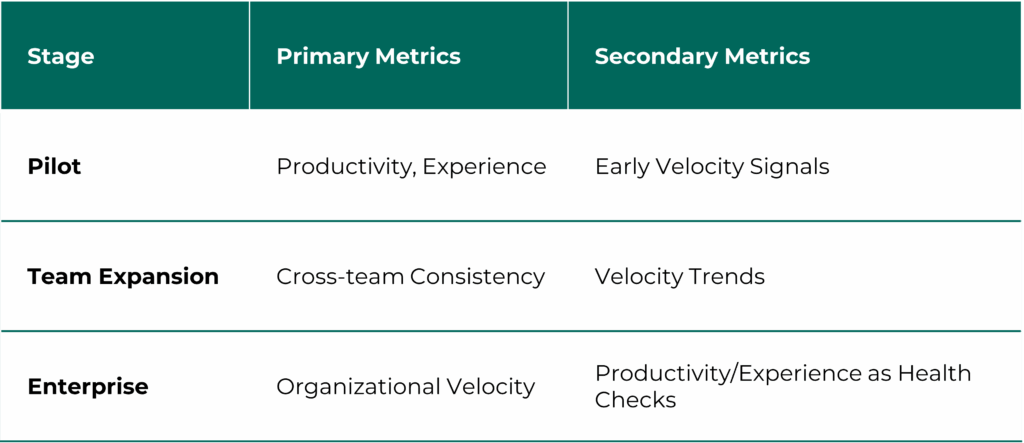
During the pilot stage, focus on developer productivity and experience to prove the concept works. As you expand to multiple teams, begin tracking consistency across groups and watch for uneven workflows. At enterprise scale, shift emphasis to organizational velocity and tie metrics to business KPIs. Don’t measure enterprise outcomes during a pilot, you’ll set unrealistic expectations and undermine confidence in the program.
Avoid Measuring Pitfalls
Even with the right metrics identified, implementation mistakes can undermine your measurement program.
- Measuring too early: Give teams time to build competence before expecting velocity gains. Developers need to learn prompting patterns and integrate Copilot into their workflows before productivity metrics become meaningful.
- Inconsistent baselines: Establish pre-Copilot benchmarks before rolling out. Without a clear “before” picture, you can’t demonstrate improvement.
- Perverse incentives: If you reward “suggestions accepted,” developers will accept bad suggestions. Measure outcomes, not activity.
- Ignoring qualitative data: Surveys and developer feedback catch what dashboards miss. A developer who says “I finally enjoy working on legacy code” tells you something no metric can capture.
Good metrics create clarity. Bad metrics create gaming. Design your measurement approach to reward the outcomes you want.
Moving Forward
Lines of code won’t prove GitHub Copilot’s value. Meaningful metrics across productivity, experience, and velocity will. As GitHub Copilot evolves toward agentic workflows—where AI agents plan, execute, and collaborate on multi-step tasks—measurement becomes even more critical. You’ll need to assess not just individual productivity, but how well humans and AI agents work together across the development lifecycle.
Organizations that invest in thoughtful measurement now will be positioned to capture the full benefits of AI-assisted development. Those that rely on vanity metrics will continue wondering why their pilots never scale.
Ready to design a metrics framework for your GitHub Copilot adoption?
Lantern’s GitHub services team helps organizations move from pilots to enterprise-scale adoption with governance, enablement, and measurable outcomes.